
Jump to Recipe
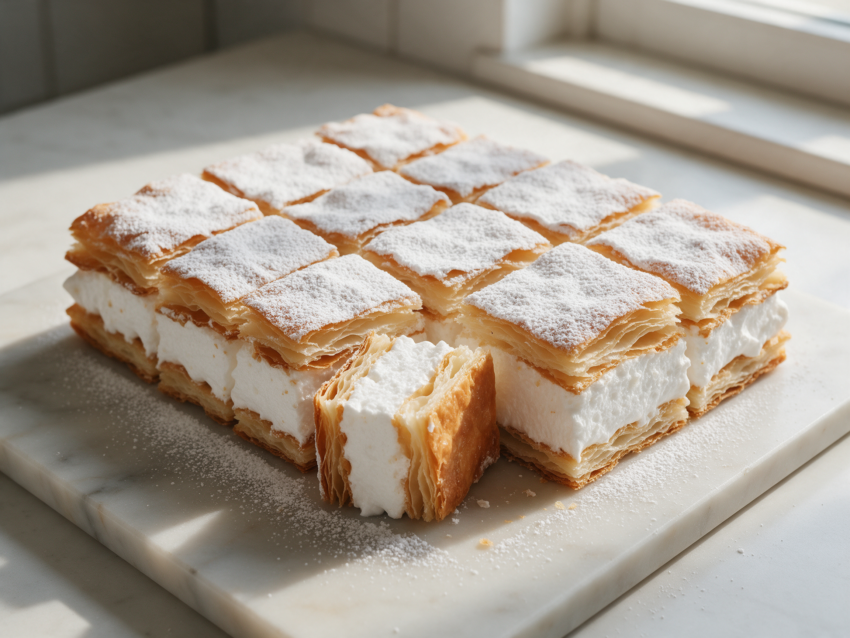
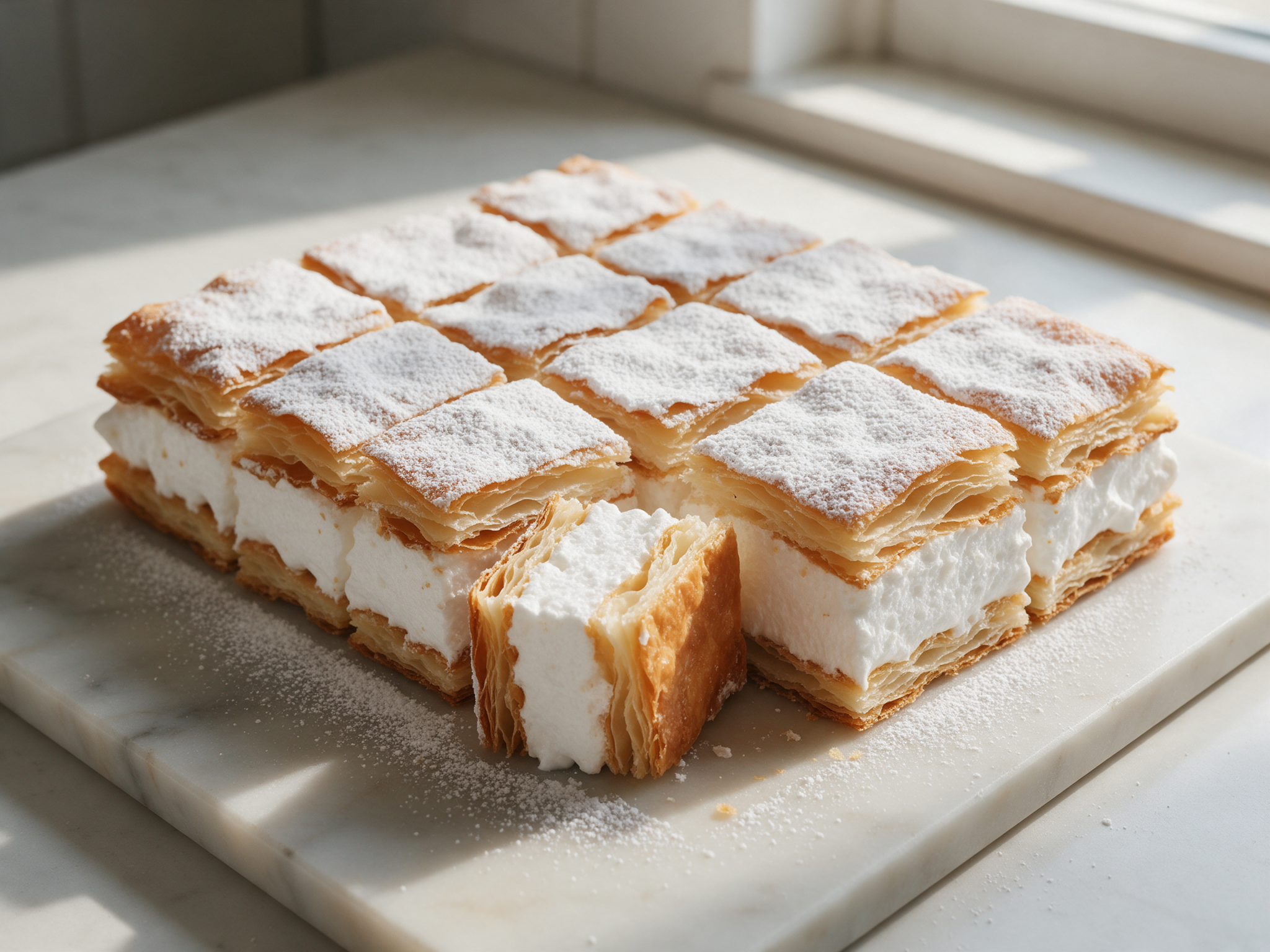
There’s something almost theatrical about cutting into sampita for the first time. The knife slides through crisp pastry, sinks into a meringue filling that barely resists, then hits pastry again. It’s Balkan bakery window dressing, and it earns the attention.
I first had this in a Sarajevo pastry shop, sold by the square, dusted heavy with powdered sugar. The filling isn’t custard and it isn’t whipped cream. It’s an Italian meringue much like the crushed topping in Uruguay’s peach meringue trifle, egg whites cooked by hot sugar syrup, set just enough with gelatin to hold its shape when sliced.
Sampita traces back to Ottoman-era pastry traditions across the Balkans, a close cousin to Turkish şambali-style sweets. Every bakery from Belgrade to Zagreb has its own version, but the bones stay the same: two pastry sheets stacked like Costa Rica’s layered torta chilena, one thick meringue center.
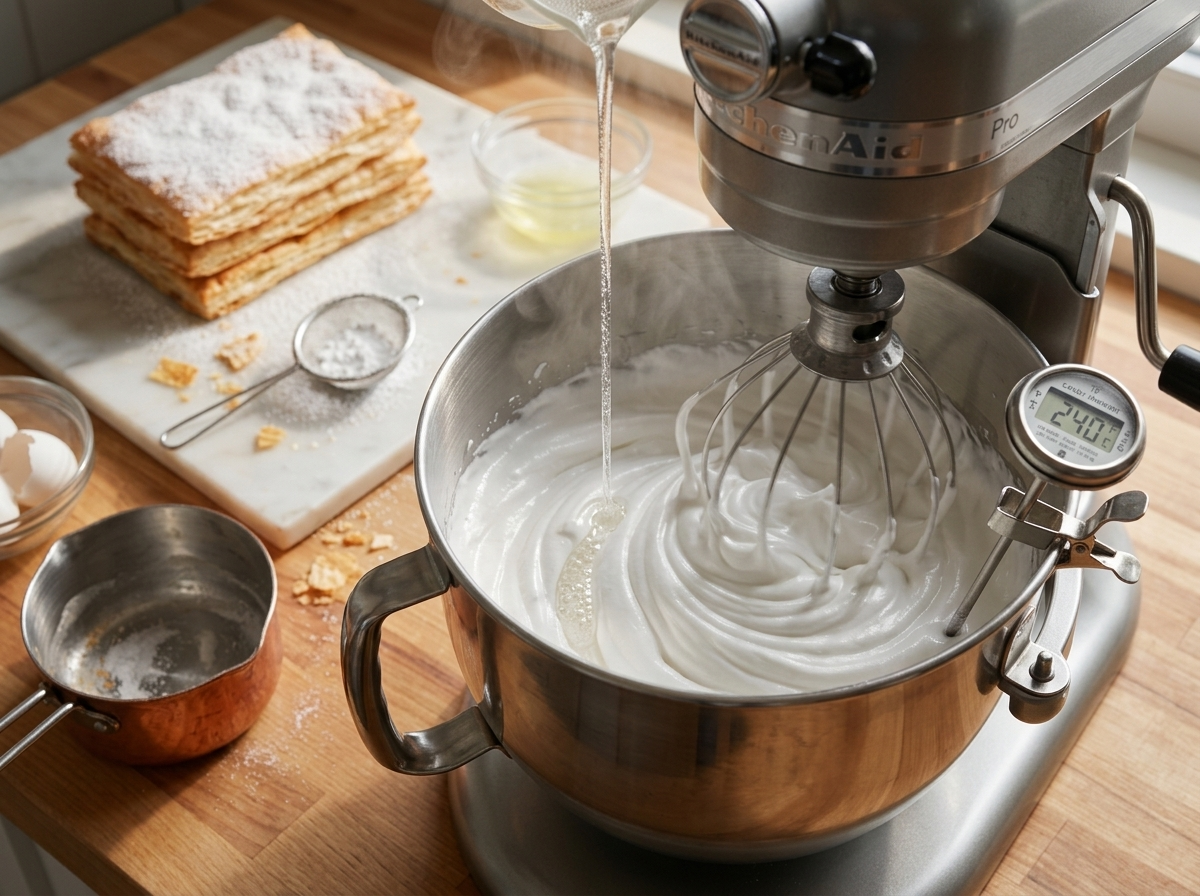
The one real trick is the syrup stage. Undercook it and the meringue stays loose and never sets. Get it to 115C / 240F and the filling turns glossy and holds clean squares after a few hours in the fridge.
Why You’ll Love This Recipe
- Crisp pastry contrasts a cloud-light meringue center
- Make it a day ahead, it slices cleaner after an overnight chill
- No oven-baked custard, just whipped egg whites and hot syrup
- Feeds a crowd from one 9×13 pan, no special equipment needed
Ingredient Notes
- Puff pastry: Use store-bought all-butter puff pastry, thawed but still cold. Homemade works too if you’ve got the time.
- Egg whites: Fresh egg whites whip up with the best volume. Pasteurized egg whites work if you want extra peace of mind, since the syrup only partially cooks them.
- Granulated sugar: Dissolves fastest for the syrup and keeps the meringue pale. Brown sugar changes the color and flavor, so skip it here.
- Powdered gelatin: Holds the meringue’s shape once chilled. Agar agar works as a vegetarian swap, use about half the amount since it sets firmer.
- Lemon juice: A small splash stabilizes the egg whites while whipping. White vinegar works in a pinch.
- Vanilla extract: Adds warmth to an otherwise plain filling. Skip imitation vanilla if you can, it reads flat against all that sugar.
Sampita: Balkan Puff Pastry Meringue Layer Cake
Ingredients
Method
- Heat the oven to 200C / 400F. Line two sheet pans with parchment paper.
- Unroll the puff pastry sheets onto the sheet pans. Prick each sheet all over with a fork so it doesn't puff too much in the oven.
- Bake for 15 to 18 minutes, until deep golden brown and crisp. Cool completely on the pans, then trim each sheet to fit your 9x13 inch (23x33 cm) baking pan.
- Sprinkle the gelatin over the 60 ml cold water in a small bowl. Let it sit for 5 minutes to bloom, then melt it in the microwave for 10 to 15 seconds, or set the bowl over a pot of simmering water until clear.
- Combine the sugar and 90 ml water in a small saucepan. Bring to a boil over medium heat and cook, without stirring, until a candy thermometer reads 115C / 240F.
- While the syrup cooks, whip the egg whites in a stand mixer on medium speed until they hold soft peaks.
- With the mixer running on medium-low, pour the hot syrup down the side of the bowl in a thin stream, avoiding the whisk. Add the lemon juice, then turn the mixer to high speed and whip for 8 to 10 minutes, until the meringue is glossy, holds stiff peaks, and the bowl feels just barely warm to the touch.
- Add the melted gelatin and vanilla extract. Whip for 1 more minute to combine fully.
- Place one pastry sheet in the bottom of the 9x13 inch (23x33 cm) pan. Spread the meringue filling evenly over the top. Set the second pastry sheet on top, pressing down gently.
- Chill the assembled cake, uncovered, for at least 2 hours, or overnight, until the filling is firm to the touch.
- Dust the top heavily with powdered sugar using a fine sieve. Cut into 12 squares with a sharp knife, wiping the blade clean between cuts.
Notes
- Cook the syrup on medium heat, not high, so it doesn't scorch before hitting 115C / 240F.
- Bloom the gelatin fully before melting it, undissolved granules show up as lumps in the filling.
- Trim pastry sheets to the exact pan size before assembling for clean, even layers.
- Wipe the knife clean between cuts for neat squares, the meringue sticks otherwise.
Tips for Success
- Cook the sugar syrup to exactly 115C / 240F using a candy thermometer, guessing by eye leaves the meringue soft and runny.
- Whip the egg whites to soft peaks before streaming in the hot syrup, a technique similar to shaping Ecuadorian guava meringue cookies, this keeps the meringue from deflating.
- Pour the syrup down the side of the bowl in a thin stream, never directly onto the whisk or it splatters.
- Chill the assembled cake at least 2 hours before cutting, the gelatin needs that time to fully set the filling.
- Trim the baked pastry sheets to fit the pan while they’re still slightly warm, they crack less than fully cooled sheets.
Variations
- Fold in 100g melted dark chocolate to the finished meringue for a chocolate sampita variation.
- Swap gelatin for agar agar, using half the amount dissolved in boiling water, for a vegetarian-set filling.
- Spread a thin layer of apricot jam under the meringue for a tangier, fruitier version.
Storage and Reheating
Sampita keeps well in the fridge for 3 to 4 days, covered tightly so the pastry doesn’t pick up other smells. Keep it in the same pan or transfer squares to an airtight container.
This isn’t a dessert you reheat. The meringue filling is meant to stay cold and set, and any warmth turns it soft and weepy. Serve straight from the fridge for the cleanest slices.
Freezing isn’t recommended. The pastry loses its crispness and the meringue’s texture turns grainy once thawed.
Serving Suggestions
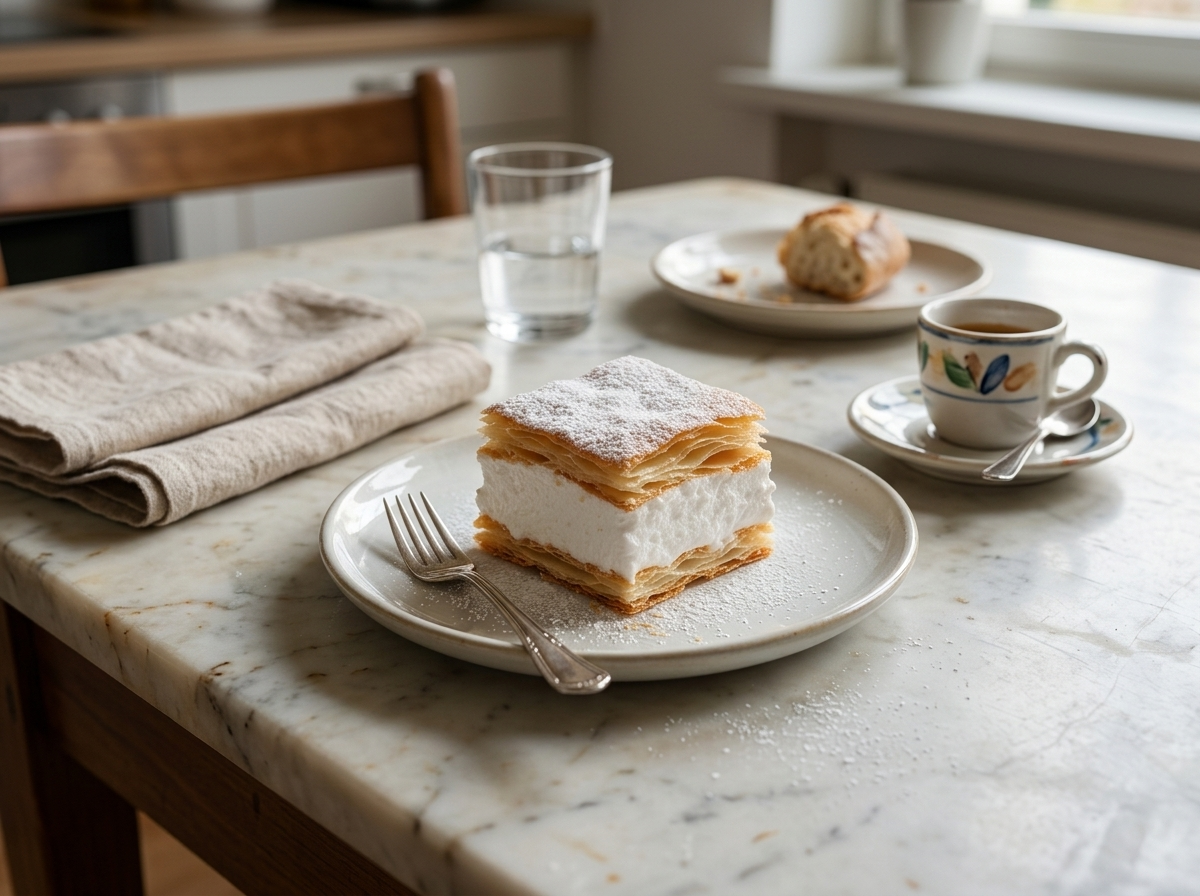
Sampita is rich enough to serve in small squares alongside strong coffee or tea. In the Balkans it’s a bakery treat, not usually a home dessert, so a plain plate and a small espresso cup is all it needs.
For a bigger spread, add a few pieces of baklava or a bowl of fresh sour cherries on the side.
I like serving it after a summer barbecue. Cold squares straight from the fridge sit better after a hot meal than something warm and heavy.
FAQ
Why is my sampita filling runny instead of holding its shape when I slice it?
The sugar syrup likely didn’t reach 115C / 240F, or the gelatin wasn’t fully bloomed and melted before folding it in. Both leave the meringue loose. Also give the assembled cake a full 2 hours in the fridge, cutting it too early looks fine but slumps within minutes.
Can I use agar agar instead of gelatin in sampita’s meringue filling?
Yes, agar agar works as a vegetarian swap. Use about half the amount of powdered gelatin called for, dissolved in boiling water instead of cold, since agar sets firmer and needs heat to activate. The texture ends up slightly denser but still holds clean squares.
How long does sampita keep in the fridge, and can I freeze it?
Sampita keeps 3 to 4 days in the fridge, covered so the pastry doesn’t soften from moisture. Freezing isn’t recommended, the pastry loses its crispness and the meringue turns grainy and weepy once thawed and chilled again.
What pairs well with sampita’s sweet meringue filling for serving?
Strong black coffee or unsweetened tea balances the sweetness well, which is how it’s usually served in Balkan bakeries. A few fresh sour cherries or a small glass of cold water on the side also cuts through the richness nicely.
Is sampita gluten free?
No, standard sampita isn’t gluten free because it uses wheat-based puff pastry. You can swap in a gluten-free puff pastry brand for the pastry layers, the meringue filling itself is naturally gluten free since it’s just egg whites, sugar, and gelatin.
What’s the difference between sampita and baklava?
Sampita uses two sheets of puff pastry with a whipped meringue filling in the middle, while baklava layers many thin phyllo sheets with chopped nuts and soaks the whole thing in syrup. Sampita is lighter and creamier, baklava is denser and syrup-soaked throughout.
More from the kitchen
