
Jump to Recipe
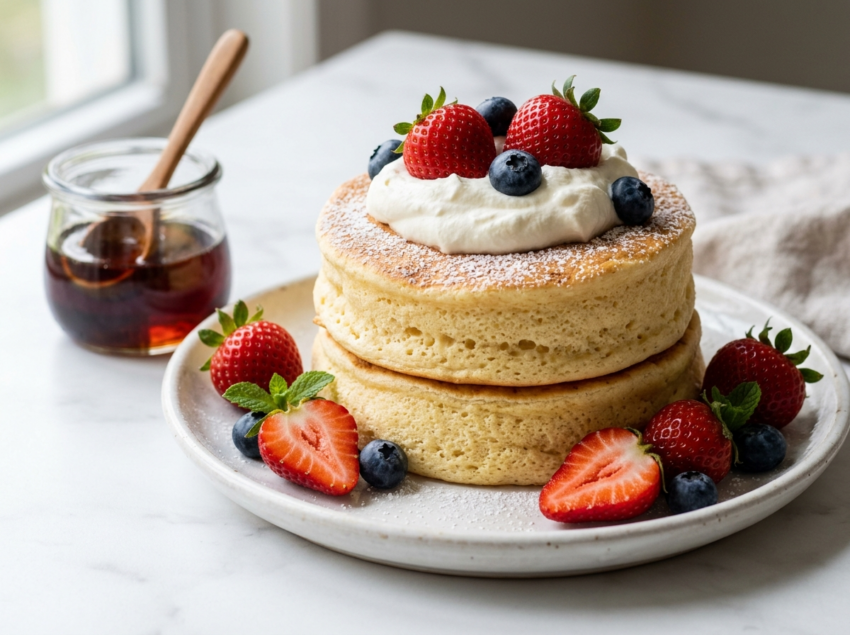
There’s something almost surreal about a pancake that jiggles when you poke it.
Japanese soufflé pancakes have been a fixture in Tokyo cafes for years. The texture sits somewhere between a cloud and a classic pancake – light enough to feel like air, but with enough structure to stack. They’re not a quick weekday breakfast. They reward patience and a light hand.
The technique comes down to one thing: a well-beaten meringue. Fold it too hard and you lose the lift. Cook on too high a heat and the outside burns before the center sets.
I’ve tested this recipe more times than I care to count. The version here uses cake flour for tenderness, a touch of lemon juice to stabilize the whites, and a low, covered pan to cook them through without scorching. It works consistently.
Why You’ll Love This Recipe
- Incredibly light texture from stiff meringue folded gently into batter
- No oven needed – just a nonstick pan with a lid
- Looks impressive but uses basic pantry staples
- Customizable toppings from berries to matcha cream
Ingredient Notes
- Cake flour: Cake flour has lower protein than all-purpose, which keeps the pancakes tender and soft. If you don’t have it, substitute with 3 tbsp cornstarch mixed into 1/2 cup all-purpose flour per 1/2 cup cake flour.
- Cream of tartar: Helps stabilize the egg whites so the meringue holds its stiff peaks longer. A few drops of lemon juice or white vinegar works as a substitute.
- Whole milk: Full-fat milk gives the batter a slightly richer base. Oat milk works as a dairy-free swap, though the pancakes may be marginally less tender.
- Eggs: You need to separate them carefully – any yolk in the whites will prevent the meringue from whipping properly. Use cold eggs straight from the fridge; they separate more cleanly.
- Vanilla extract: Pure vanilla extract gives a clean, warm flavor. Vanilla bean paste works too and adds visible specks to the batter.
- Heavy whipping cream: For the topping. Whip to soft peaks so it sits gently on the pancakes without weighing them down. Coconut cream is a solid dairy-free alternative.
Japanese Soufflé Pancake Dessert with Whipped Cream and Fresh Berries
Ingredients
Method
- Separate the eggs into two clean bowls. Make sure no yolk gets into the whites or the meringue won't whip properly.
- Whisk the egg yolks with 10 g of the granulated sugar until pale and slightly thickened, about 1 minute.
- Add the milk, vanilla extract, and neutral oil to the yolk mixture and whisk to combine.
- Sift the cake flour and baking powder directly into the yolk mixture and stir until smooth with no lumps. Set aside.
- Using an electric hand mixer on medium speed, beat the egg whites with cream of tartar until foamy, about 1 minute.
- Gradually add the remaining 40 g of sugar in three additions while continuing to beat on medium-high speed.
- Beat until the meringue reaches stiff peaks - the whites should stand straight up on the whisk without drooping. This takes 3 to 4 minutes total.
- Scoop one-third of the meringue into the yolk batter and fold gently with a wide spatula using slow J-strokes until just combined.
- Add the remaining meringue in two more additions, folding each time until no white streaks remain. Stop as soon as it looks uniform - don't over-fold.
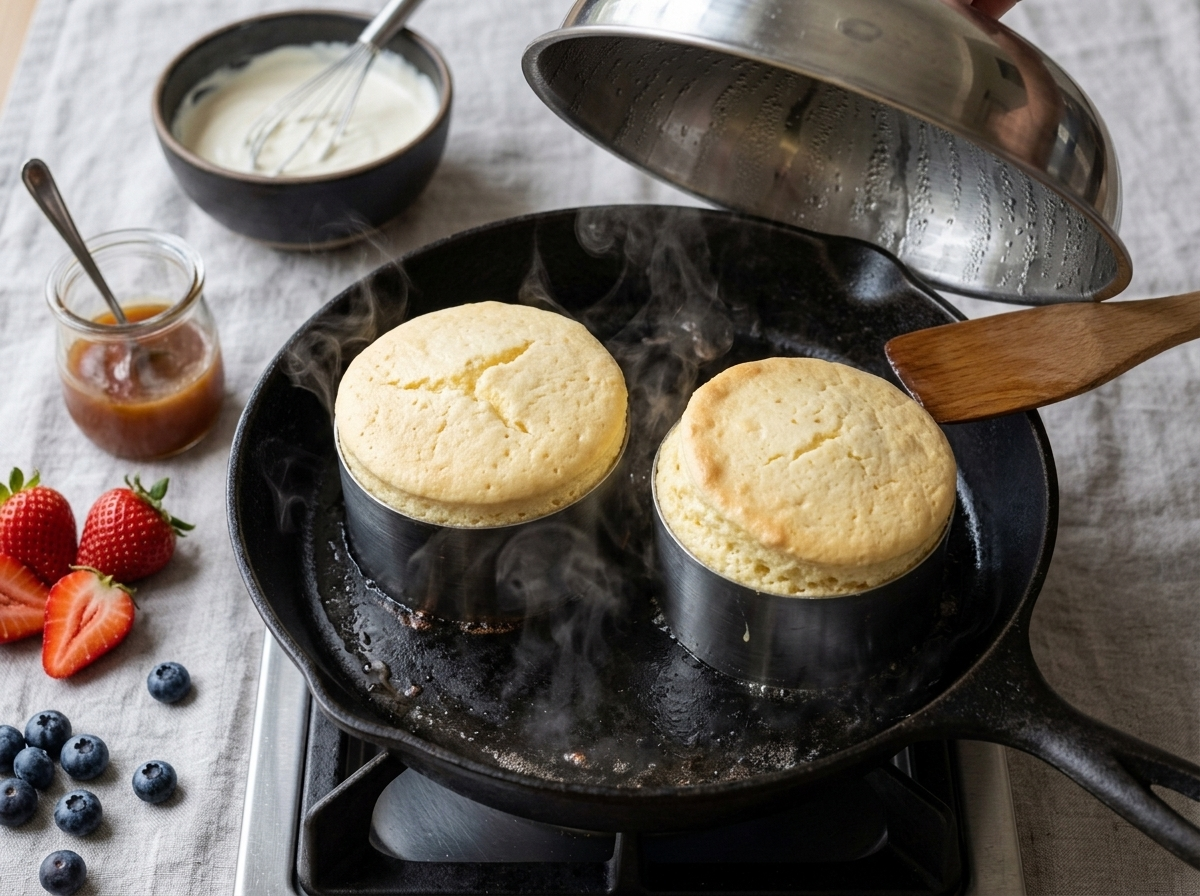
- Heat a nonstick skillet over the lowest possible heat. Add a small knob of butter and let it melt, then place 3-inch ring molds in the pan and grease the insides lightly.
- Spoon or pipe the batter into the molds, filling each about two-thirds full. Add 1 tbsp of water to the pan next to (not inside) the molds and immediately cover with a lid.
- Cook for 4 to 5 minutes until the tops look mostly set. Add another 1 tbsp of water to the pan, cover again, and cook for a further 3 to 4 minutes.
- Carefully remove the ring molds using tongs. Slide a wide offset spatula under each pancake and flip gently in one smooth motion.
- Cover and cook the second side for 3 to 4 minutes until the pancakes are cooked through and spring back lightly when pressed. They should be golden on both sides.
- Whip the heavy cream with 1 tbsp powdered sugar to soft peaks.
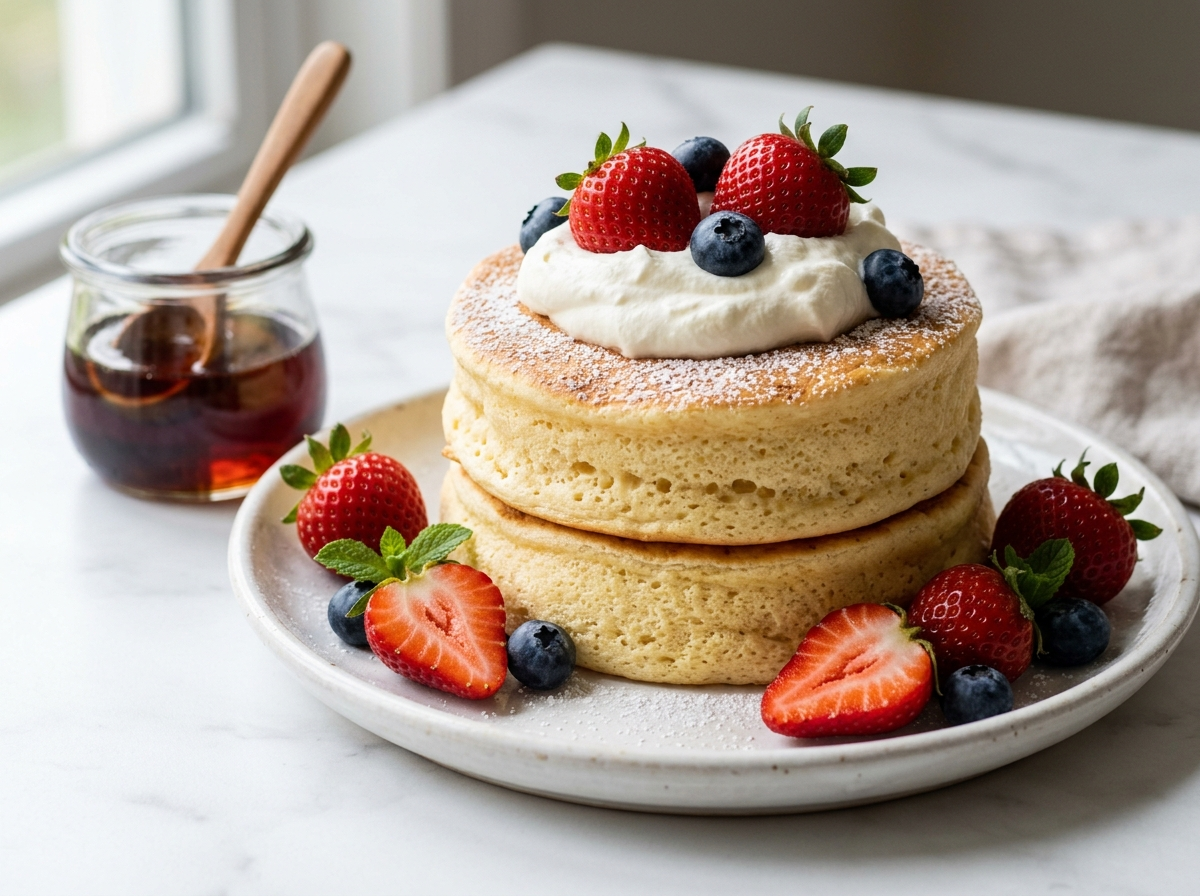
- Transfer the pancakes to plates immediately. Add a generous dollop of whipped cream, arrange fresh berries alongside, and dust with powdered sugar.
- Serve within 5 minutes for the best jiggle and height.
Notes
Tips for Success
- Whip egg whites to stiff peaks – they should stand straight up when you pull the whisk out.
- Fold the meringue into the yolk batter in three additions using a wide spatula and slow J-strokes.
- Cook on the lowest heat setting your burner allows – if the pan smokes at all, it’s too hot.
- Add 1 tbsp of water to the pan before covering with a lid to create steam that cooks the tops.
- Use ring molds lightly greased with butter to get uniform tall stacks without spreading.
Variations
- Matcha soufflé pancakes: replace 1 tsp cake flour with sifted ceremonial-grade matcha powder.
- Strawberry milk version: fold 2 tbsp freeze-dried strawberry powder into the yolk batter before combining.
- Black sesame topping: serve with black sesame paste drizzled over whipped cream instead of berries.
Storage and Reheating
Japanese soufflé pancakes are best eaten immediately. The meringue structure deflates within 10 to 15 minutes, so there’s no practical way to store a finished stack and retain the texture.
If you need to prep ahead, mix the yolk batter up to 4 hours in advance and keep it covered in the fridge. Beat the egg whites fresh just before cooking.
Leftover cooked pancakes can be refrigerated for up to 1 day in an airtight container. Reheat in a nonstick pan over low heat with a lid for 2 to 3 minutes per side, or microwave on 50% power for 30 seconds. They won’t jiggle anymore, but they’ll still taste good.
Serving Suggestions
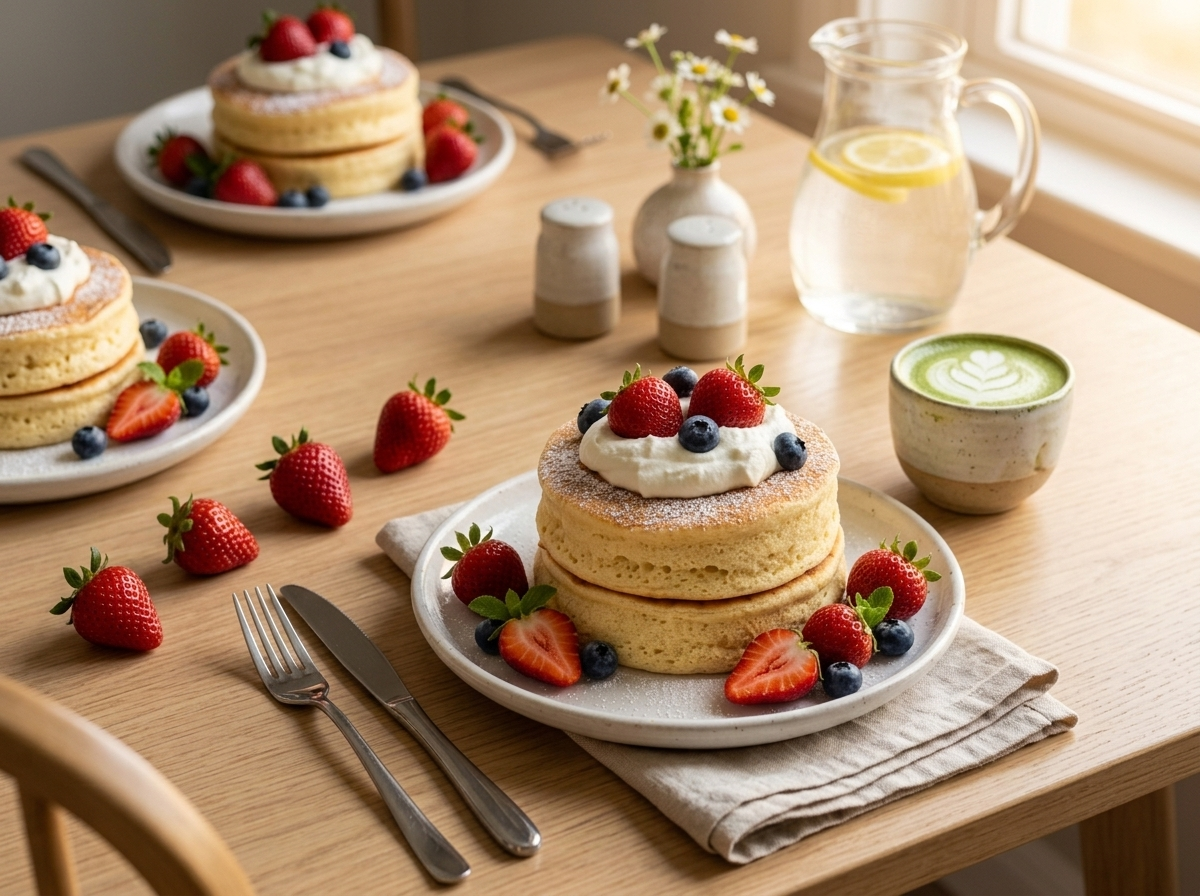
The most straightforward way to serve these is with a generous spoonful of lightly whipped cream and a handful of mixed fresh berries – strawberries, raspberries, and blueberries all work. A dusting of powdered sugar over the top is all you need to finish.
For a more indulgent dessert presentation, drizzle with a warm honey or maple syrup alongside a scoop of vanilla ice cream. The contrast of warm pancake and cold ice cream is worth trying at least once.
These also pair well with a small pot of hojicha or a lightly sweetened matcha latte if you want to keep the Japanese theme going through the whole meal.
FAQ
Why do my Japanese soufflé pancakes deflate right after cooking?
Deflation happens when the meringue was either under-whipped or over-folded into the batter. Make sure your egg whites reach stiff peaks before folding, and stop as soon as the batter looks uniform – don’t overwork it.
Can I use all-purpose flour instead of cake flour in soufflé pancakes?
You can, but the texture will be slightly denser and chewier. For a closer result, mix 3 tbsp of cornstarch with the all-purpose flour to lower the protein content before measuring.
How do I know when the soufflé pancakes are cooked through without burning the bottom?
The tops should look mostly set and slightly dry before you flip – usually after 4 to 5 minutes on low heat with a lid. If the bottom browns before the top sets, your heat is too high.
What toppings go well with Japanese soufflé pancakes for a dessert spread?
Soft whipped cream and fresh strawberries are the classic choice. Matcha cream, red bean paste, and mango compote are popular alternatives that lean into the Japanese cafe style.
Are Japanese soufflé pancakes gluten-free?
No, this recipe uses cake flour which contains gluten. A 1:1 gluten-free baking flour can be substituted, but the texture may be slightly less airy and the pancakes more fragile to flip.
What is the difference between Japanese soufflé pancakes and regular American pancakes?
American pancakes use a simple leavened batter and cook flat and dense by comparison. Japanese soufflé pancakes get their height and jiggle from a folded-in meringue, which gives them a much softer, almost custard-like interior.
Related recipes
