
Jump to Recipe
There’s something almost hypnotic about the color of fresh pandan juice. That deep, grassy green against white coconut milk – it looks like it belongs in a patisserie window, but you’re making it on a Tuesday afternoon.
This cake is a Southeast Asian classic. You’ll find versions of it across Malaysia, Indonesia, Singapore, and the Philippines, usually at family gatherings or on festive tables. It holds its shape beautifully, slices cleanly, and travels well – no frosting to smear, no crumbs to scatter.
The technique is simple. You’re essentially making two agar agar jellies and layering them while controlling temperature so they set against each other without merging. No baking, no stand mixer, no special equipment.
Fresh pandan leaves give you a cleaner, more floral flavor than extract. If you can find them at an Asian grocery, use them. If not, good-quality extract works fine and the recipe notes tell you how much.
Why You’ll Love This Recipe
- No oven needed – just stovetop and a jelly mold
- Fresh pandan gives a floral, grassy flavor extract can’t match
- Holds its shape for hours, perfect for parties
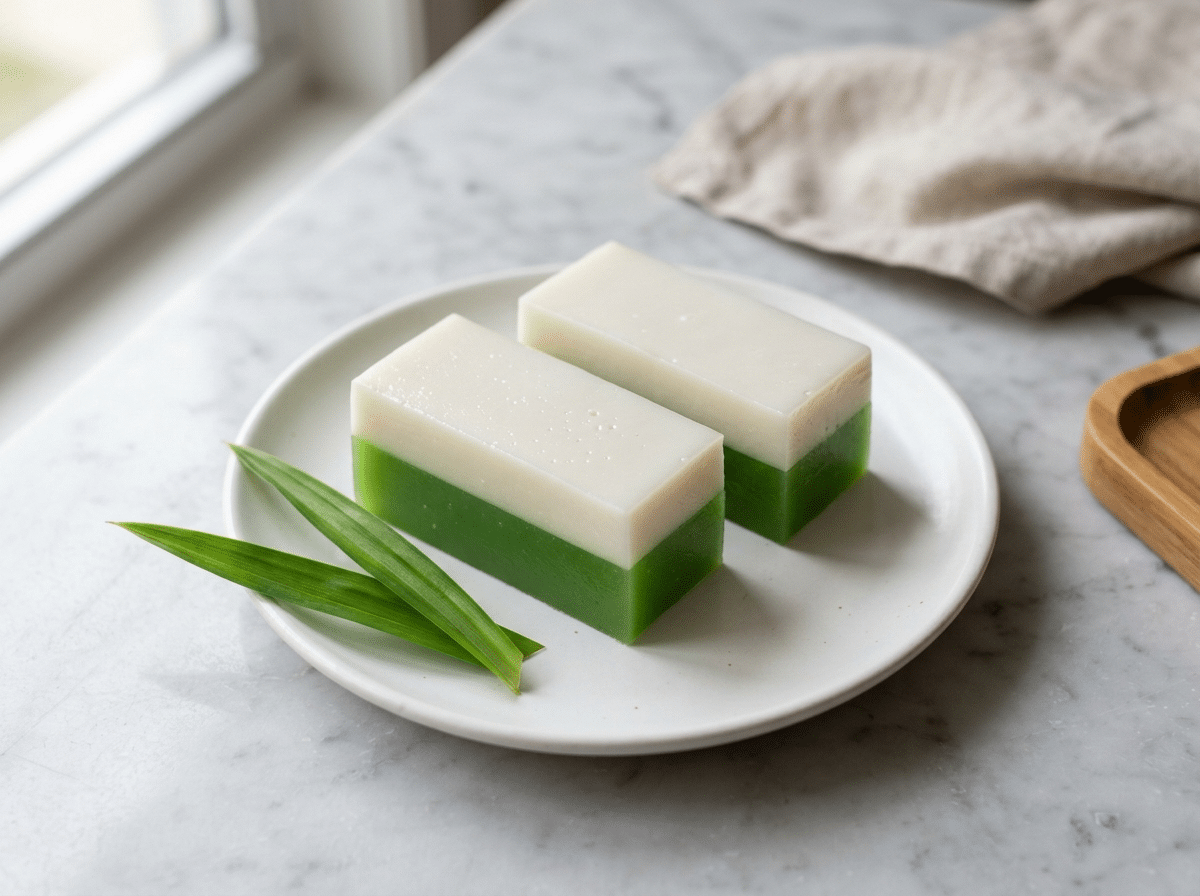
- Slices cleanly into neat, photogenic two-toned layers
Ingredient Notes
- Pandan leaves: Fresh leaves blended with water give the brightest green color and a clean floral scent. If unavailable, substitute 1 tsp pandan extract plus 200 ml plain water for the pandan juice.
- Agar agar powder: Use pure agar agar powder, not flakes – flakes dissolve inconsistently and can leave lumps. One teaspoon of powder sets about 500 ml liquid to a firm jelly.
- Coconut milk: Full-fat canned coconut milk gives the richest, creamiest white layer. Light coconut milk will set but the layer will taste thin and slightly watery.
- Pandan extract: If using extract instead of fresh leaves, add it off the heat to preserve the fragrance. Too much heat drives off the delicate aroma quickly.
- Caster sugar: Fine caster sugar dissolves faster in the hot liquid than granulated sugar. Regular granulated white sugar works fine if that’s what you have.
- Salt: A small pinch of salt in the coconut layer balances the sweetness and makes the coconut flavor read as deeper and more savory-sweet.
Pandan Coconut Jelly Cake
Ingredients
Method
- Place the chopped pandan leaves and 250 ml water into a blender. Blend on high for 90 seconds until the leaves are fully broken down and the liquid is a deep green.
- Pour the mixture through a fine-mesh sieve set over a bowl, pressing the pulp firmly with a spoon to extract all the juice. You should get about 200 ml of bright green pandan juice. Discard the pulp.
- Combine the pandan juice, 300 ml water, agar agar powder, and caster sugar in a medium saucepan. Stir well to disperse the agar powder before turning on the heat.
- Heat over medium heat, stirring constantly, until the mixture comes to a gentle boil and the sugar has fully dissolved, about 5 to 7 minutes. Reduce to low and keep warm.
- Pour the pandan mixture into your lightly wetted jelly mold or dish in an even layer. Tap the mold gently on the counter twice to release any air bubbles.
- Leave the pandan layer to set at room temperature for 20 to 25 minutes. It should be firm to the touch but slightly tacky on the surface - not fully rigid.
- While the pandan layer is setting, combine the coconut milk, 150 ml water, agar agar powder, sugar, and salt in a second saucepan. Stir to combine before heating.
- Heat over medium-low heat, stirring gently and continuously, until the mixture is steaming and the sugar has dissolved completely, about 6 to 8 minutes. Do not bring to a rolling boil or the coconut milk may split. Remove from heat.
- Let the coconut mixture cool for 3 to 4 minutes, stirring occasionally, until it no longer feels scalding when tested on your wrist. It should still be liquid and pourable.
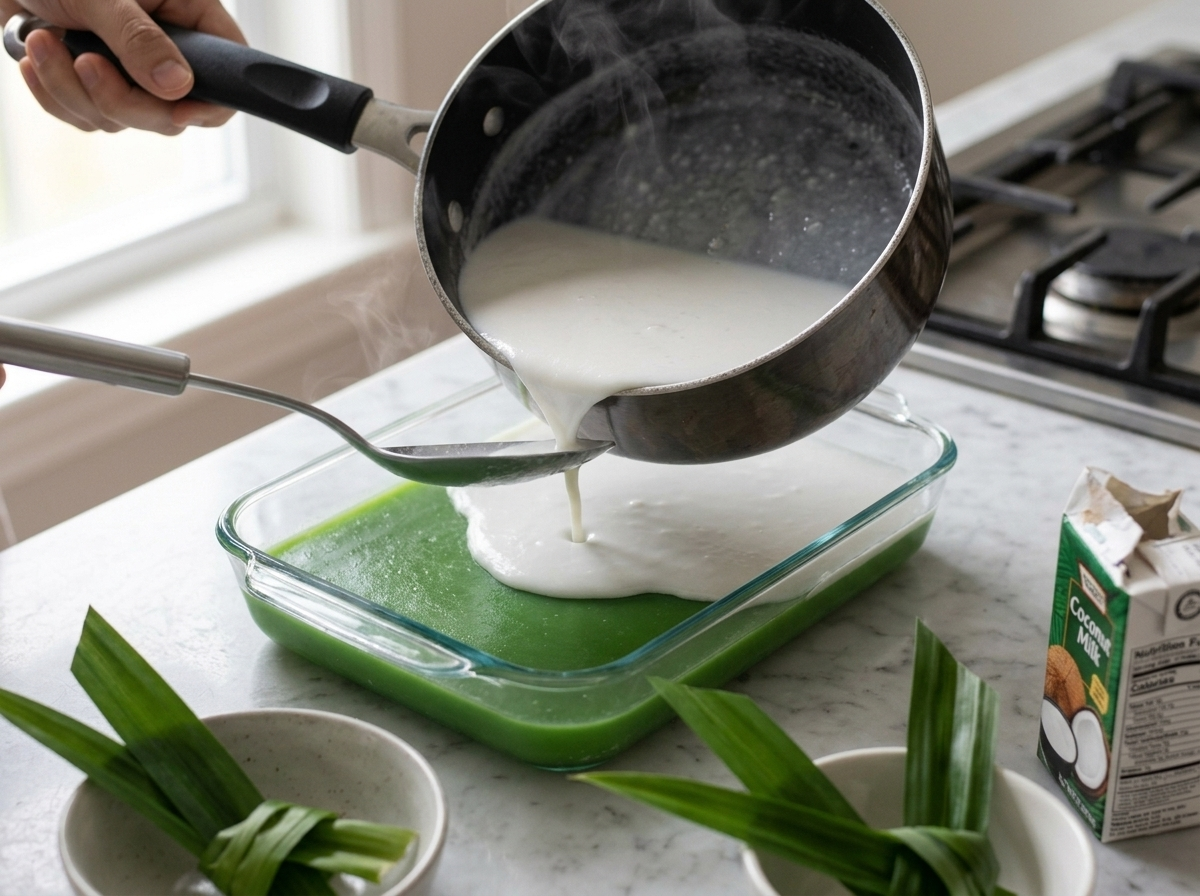
- Check the pandan layer - it should be set but still tacky. Pour the coconut mixture slowly over the back of a spoon held just above the pandan surface so it lands gently without breaking through.
- Let the full mold sit undisturbed at room temperature for 10 minutes, then transfer carefully to the fridge. Chill uncovered for the first 30 minutes, then cover loosely with plastic wrap.
- Chill for at least 3 hours, or overnight for best results, until the cake is completely firm throughout.
- Run a thin knife or offset spatula around the inside edge of the mold to break the suction. Place a flat serving plate face-down over the mold, then flip both together in one confident motion.
- Lift the mold away gently. If the cake doesn't release immediately, leave it inverted for 30 seconds - gravity will do the work.
- Slice into rectangles or diamond shapes with a sharp knife wiped clean between cuts for the neatest edges. Serve cold.
Notes
Tips for Success
- Blend fresh pandan leaves with water for at least 60 seconds, then strain through a fine-mesh sieve for a smooth, lump-free juice.
- Pour the second layer when the first layer is just set but still slightly tacky on top – this ensures the two layers bond without cracking apart.
- Keep both saucepans on the lowest heat setting after the agar dissolves to stop premature setting before you pour.
- Wet your jelly mold lightly with cold water before pouring so the set cake releases cleanly without tearing.
- Chill the finished jelly cake uncovered for the first 30 minutes so condensation doesn’t drip onto the surface and dull the top layer.
Variations
- Add 2 tbsp thick coconut cream to the pandan layer for a richer, less translucent green base.
- Swap pandan juice for butterfly pea flower tea to create a striking purple and white two-toned jelly instead.
- Make individual portions in small silicone cups and reduce chill time to 45 minutes for a party-friendly single-serve format.
Storage and Reheating
Store the jelly cake covered in the fridge for up to 4 days. Press a sheet of plastic wrap gently onto the cut surface to prevent the edges from drying or weeping.
Don’t freeze this cake. Agar agar-based jellies become grainy and release water when thawed, and the texture won’t recover.
Serve it cold straight from the fridge. It does not need to come to room temperature and actually holds its shape better when chilled.
Serving Suggestions
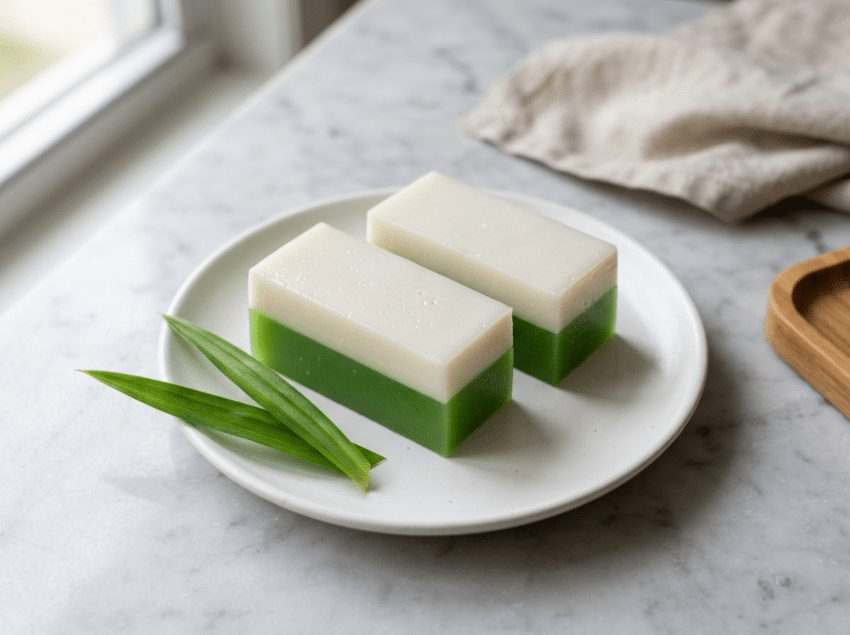
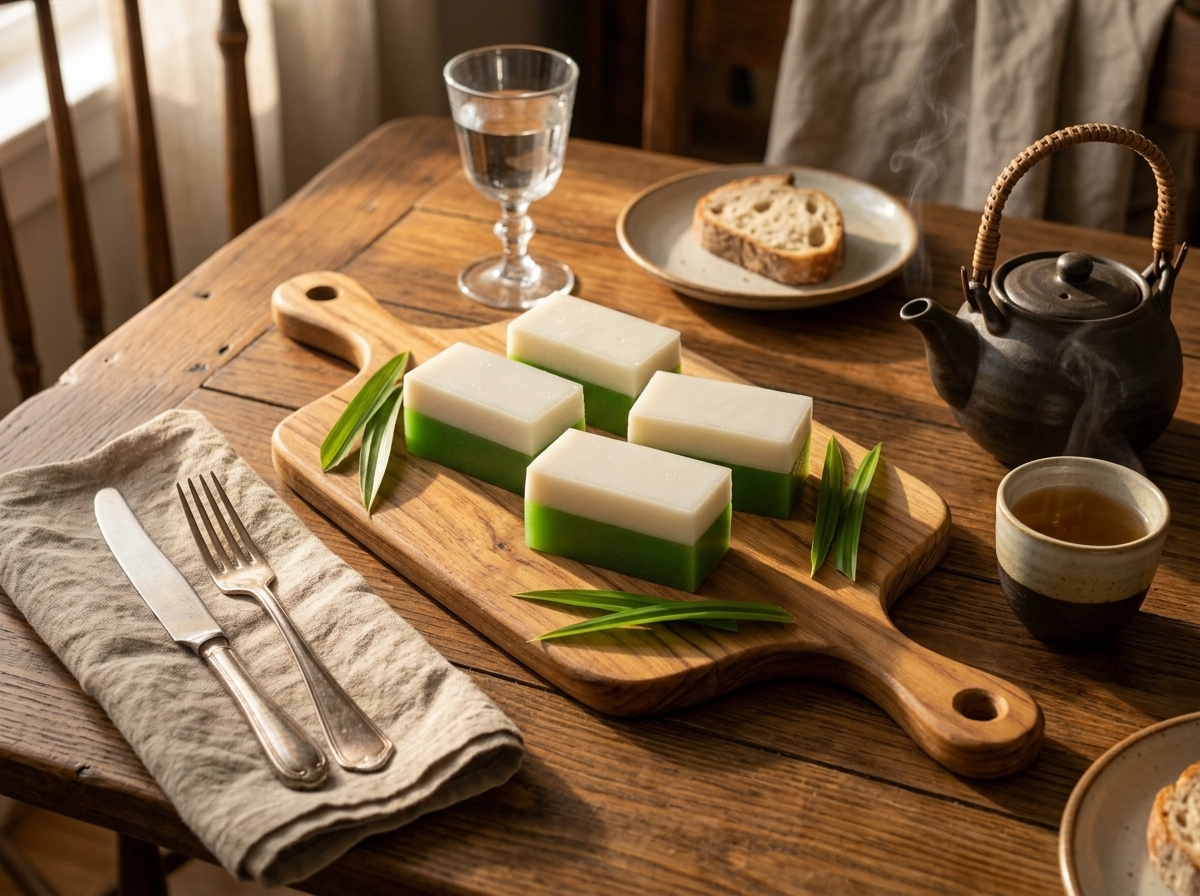
Slice the cake into rectangles or diamonds and arrange on a white plate so the two layers show clearly. A few strips of fresh pandan leaf laid alongside the slices add a simple visual cue about the flavor.
Serve it as a light dessert after a Thai or Malaysian-style meal — much like small batch coconut cupcakes do — it cuts through rich curries and spiced dishes cleanly. It also works well on a dim sum spread or as a mid-afternoon snack with jasmine tea.
For a more composed dessert plate, add a small scoop of coconut sorbet or a drizzle of thick coconut cream — similar to what makes a ginger coconut custard so satisfying — alongside each slice.
FAQ
Why is my pandan coconut jelly cake cloudy instead of clear green?
The pandan layer turns cloudy when the juice isn’t strained properly or when the agar mixture boils too hard. Strain fresh pandan juice through a fine-mesh sieve and keep the heat low once the agar has dissolved.
Can I use agar agar flakes instead of powder in this recipe?
Powder is much more reliable here. Flakes dissolve unevenly and often leave visible lumps in the finished jelly. If flakes are all you have, use about 3 times the weight and simmer longer, stirring constantly.
How do I stop the pandan and coconut layers from separating when I slice the cake?
The layers separate when the first layer is poured too cold or is fully set before the second layer goes on. Pour the second layer when the first is firm but still slightly sticky to the touch – around 20 to 25 minutes at room temperature.
What goes well with pandan coconut jelly cake at a party spread?
It pairs naturally with other Southeast Asian sweets like onde onde, kuih lapis, or mango sticky rice. A pot of jasmine tea or cold barley water alongside keeps the spread cohesive and refreshing.
Is pandan coconut jelly cake gluten-free and vegan?
Yes to both. The recipe uses agar agar (a plant-based gelling agent), coconut milk, and fresh pandan – no animal products and no gluten-containing ingredients. Check your agar agar packaging to confirm it’s processed in a gluten-free facility if you have celiac disease.
What is the difference between pandan coconut jelly cake and kuih talam?
Kuih talam uses rice flour and is steamed, giving it a denser, slightly starchy texture. Pandan coconut jelly cake uses agar agar and sets in the fridge, so the texture is firmer and more gel-like with a cleaner, glossier appearance.
