
Jump to Recipe
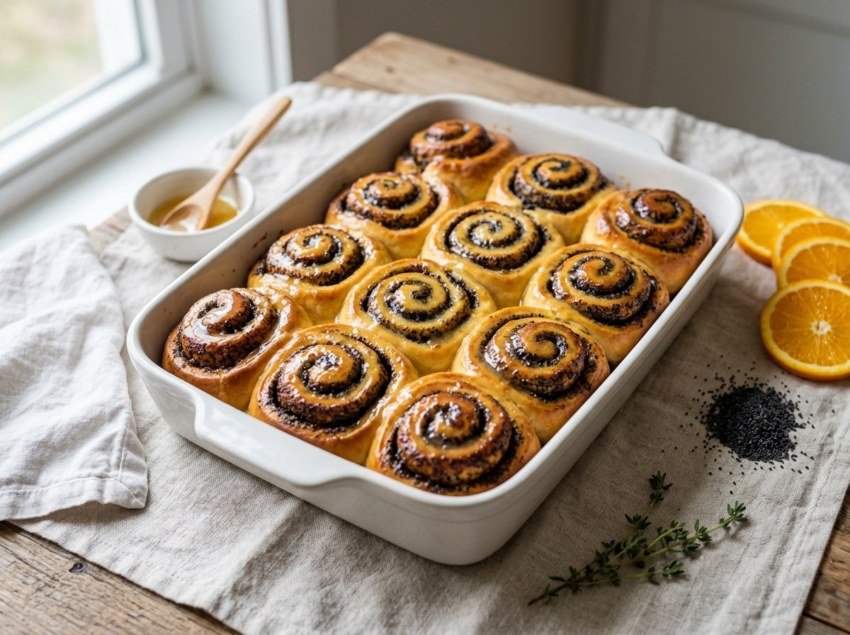
There’s something about the smell of poppy seed rolls baking that feels immediately familiar, even if you grew up nowhere near Central Europe.
I first made these after eating a version at a small bakery in Vienna. The filling was dense, not grainy, and the citrus cut right through it. I wanted that at home.
These rolls use a classic enriched dough, slightly sweet, soft enough to pull apart. The filling is cooked briefly on the stove so it holds its shape when you slice.
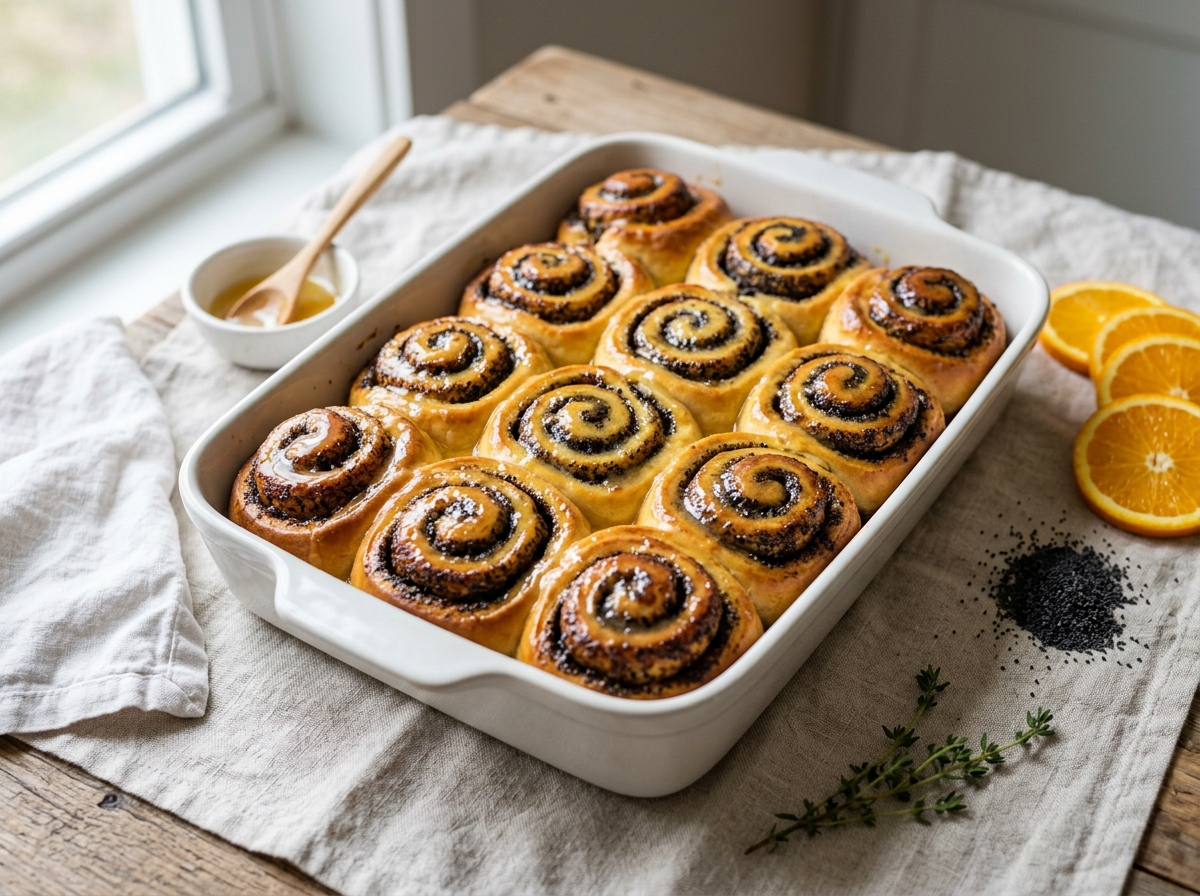
The orange and lemon glaze goes on hot from the oven. It’s thin, not thick icing, and it soaks in rather than sits on top.
Why You’ll Love This Recipe
- Filling is cooked, so it slices cleanly without falling out
- Orange glaze soaks in warm, no thick icing needed
- Dough works overnight in the fridge for easy morning baking
- One batch makes 12 rolls, good for sharing or freezing
Ingredient Notes
- Poppy seeds: Use blue-grey poppy seeds, not white. Grind them in a spice grinder or dedicated coffee grinder for a smoother, denser filling. Pre-ground poppy seed paste (sold in Central European grocers) works if you’re short on time.
- Bread flour: Higher protein gives the dough more structure and a chewier crumb. All-purpose flour works too, but the rolls will be slightly softer and less defined.
- Whole milk: Full-fat milk makes the dough richer. You can substitute oat milk for a dairy-free version, though the crumb will be a little less pillowy.
- Orange zest: Use unwaxed oranges so the zest doesn’t carry a waxy bitterness. A microplane gives the finest zest, which distributes more evenly through the filling.
- Lemon zest: Just one lemon adds brightness without overpowering. Meyer lemon works if you want a sweeter, less sharp citrus note.
- Unsalted butter: Used both in the dough and the filling. If you only have salted butter, reduce the added salt in the dough by a pinch.
- Instant yeast: Instant yeast goes straight into the flour with no proofing step needed. Active dry yeast works too, but proof it in the warm milk first for 5 minutes before using.
Poppy Seed Citrus Rolls with Orange and Lemon Glaze
Ingredients
Method
- Combine the flour, instant yeast, sugar, and salt in the bowl of a stand mixer. Stir briefly to distribute the yeast.
- Add the warm milk and eggs to the dry ingredients. Mix on low with the dough hook until a shaggy dough forms, about 2 minutes.
- Increase speed to medium and add the softened butter one or two cubes at a time, waiting for each piece to fully incorporate before adding the next. This takes about 8 minutes.
- Continue kneading on medium-high until the dough is smooth, slightly tacky, and pulls cleanly from the sides of the bowl, about 5 more minutes.
- Shape the dough into a ball, place in a lightly oiled bowl, cover with plastic wrap, and let rise at room temperature until doubled, about 60 to 75 minutes.
- Grind the poppy seeds in a spice grinder in batches until they resemble a coarse grey powder. Don't over-grind to a paste.
- Combine the ground poppy seeds, milk, sugar, butter, orange zest, lemon zest, honey, and vanilla in a small saucepan over medium heat.
- Stir constantly and cook until the mixture thickens and pulls away from the sides of the pan, about 5 to 7 minutes. It should hold a slow-moving trail when you drag a spoon through it.
- Transfer to a bowl and let cool completely to room temperature before using. Don't rush this step.
- Punch down the risen dough and turn it onto a lightly floured surface. Roll into a rectangle roughly 45 cm x 35 cm and about 5 mm thick.
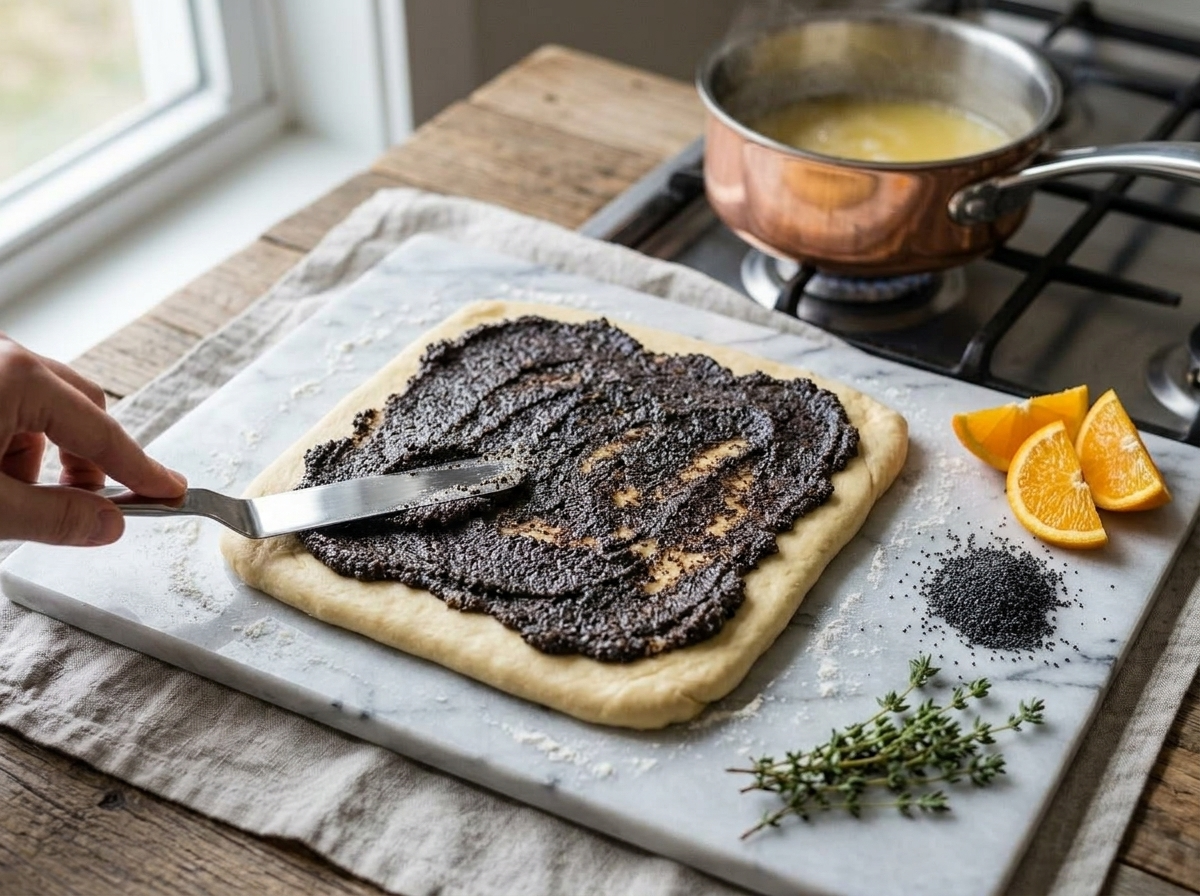
- Spread the cooled poppy seed filling evenly across the dough, leaving a 2 cm border along one long edge.
- Starting from the filled long edge, roll the dough tightly into a log. Pinch the seam closed along the border edge.
- Transfer the log to a board, cover loosely, and refrigerate for 15 minutes to firm up.
- Slice the log into 12 equal rolls using a sharp serrated knife. Each roll should be about 3.5 cm thick.
- Arrange the rolls cut-side up in a greased 9x13-inch baking dish, leaving small gaps between each roll. Cover and let proof until puffed and touching each other, about 45 to 60 minutes.
- Heat the oven to 180 C / 355 F with the rack in the center.
- Bake the rolls for 25 to 30 minutes until the tops are golden brown and the dough sounds hollow when tapped. An instant-read thermometer inserted into the dough should read 90 C / 194 F.
- While the rolls bake, whisk together the sifted powdered sugar, orange juice, lemon juice, and optional zest until smooth and pourable. The glaze should run off the spoon in a thin stream.
- Remove the rolls from the oven and pour the glaze over them immediately. Let it soak in for 5 minutes before serving.
Notes
Tips for Success
- Grind poppy seeds just before cooking the filling so the oils are fresh and the paste smells sharp and nutty.
- Cook the filling until it pulls away from the pan sides and holds a slow-moving trail, about 5 to 7 minutes.
- Roll the dough to an even 5 mm thickness so each roll bakes at the same rate and no edge burns.
- Chill the assembled log for 15 minutes before slicing to get clean, even cuts without the filling squeezing out.
- Glaze the rolls within 2 minutes of coming out of the oven so the orange syrup absorbs rather than dries on the surface.
Variations
- Swap orange zest for grapefruit zest and add a pinch of cardamom to the filling for a floral, slightly bitter version.
- Use the same dough as a braid instead of rolls, filling spread over the rectangle then twisted before baking.
- Add 2 tablespoons of dark rum to the glaze for an adult version that pairs well with afternoon coffee.
Storage and Reheating
Store cooled rolls in an airtight container at room temperature for up to 2 days. After that, the dough starts to dry out and the citrus glaze loses its shine.
For longer storage, freeze unglazed rolls individually on a sheet pan, then transfer to a zip bag. They keep for up to 2 months. Reheat from frozen at 170 C / 340 F for 10 minutes, then glaze immediately.
To refresh day-old rolls, wrap in foil and warm at 160 C / 320 F for 8 minutes. The crumb softens back without drying out further.
Serving Suggestions
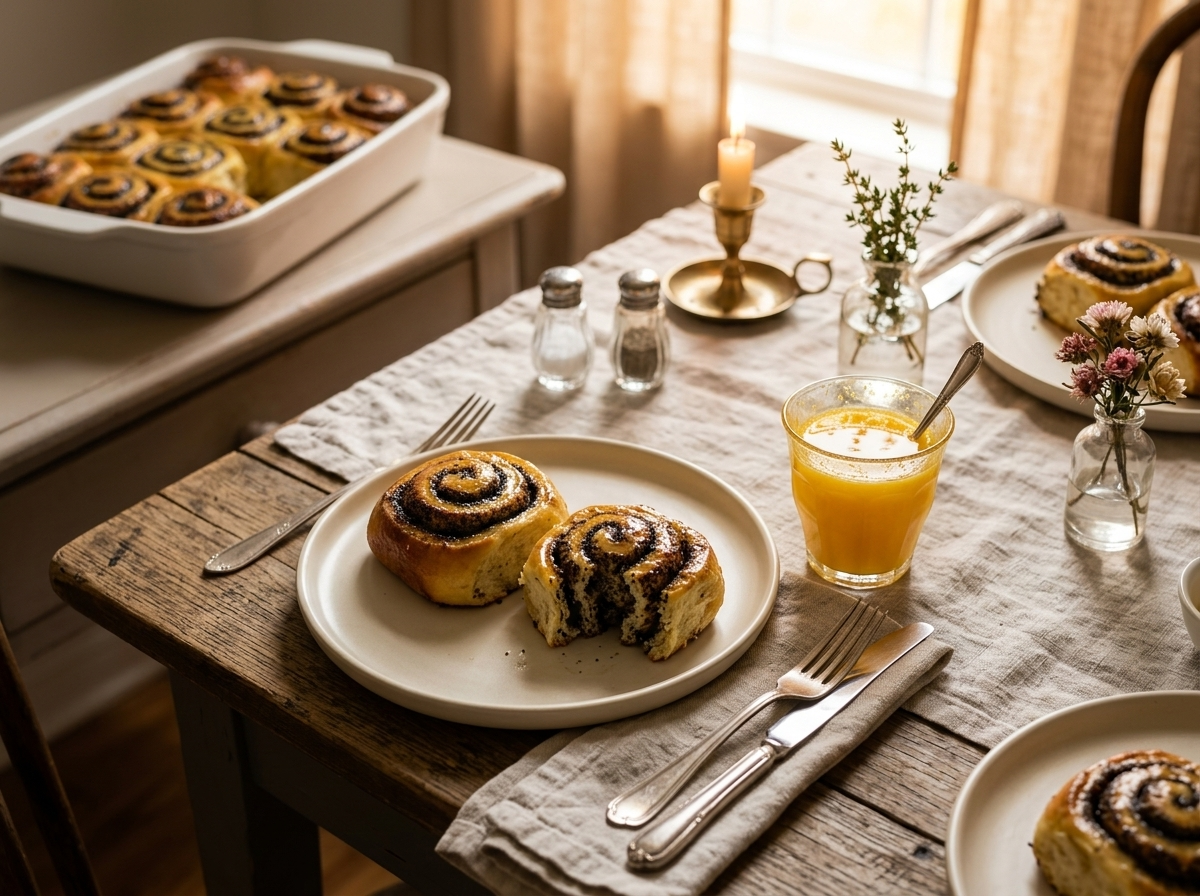
These rolls are at their best slightly warm, about 10 minutes out of the oven. Serve them on a wooden board with a small pot of extra glaze on the side for anyone who wants more citrus.
For brunch, pair with strong black coffee or a pot of Earl Grey. The bergamot in the tea picks up on the orange in the glaze.
If you’re serving these as a dessert, a small spoonful of lightly whipped cream alongside cuts through the sweetness of the filling without competing with the citrus.
FAQ
Why is my poppy seed filling leaking out of the rolls during baking?
The filling was probably too wet or too warm when you spread it. Cook the paste until it’s thick enough to hold a trail, and let it cool completely before rolling. Chilling the log before slicing also helps keep the filling in place.
Can I use whole poppy seeds instead of ground in the filling?
Whole seeds give a gritty, loose texture that won’t bind together or hold the roll shape. Grinding breaks down the seeds so the oils release and the paste becomes cohesive. Even a rough grind in a spice grinder is better than none.
Can I assemble the poppy seed citrus rolls the night before and bake them in the morning?
Yes. After slicing the rolls and placing them in the baking dish, cover tightly with plastic wrap and refrigerate overnight. In the morning, let them sit at room temperature for 30 to 45 minutes before baking so the dough finishes proofing.
What goes well with poppy seed citrus rolls for a brunch spread?
Strong coffee or Earl Grey tea are the natural match since both complement the orange glaze without overpowering the citrus. Fresh fruit, especially blood orange segments or thin grapefruit slices, adds contrast without making the spread feel heavy.
Are these poppy seed rolls dairy-free?
As written, no. They contain whole milk and butter in both the dough and the filling. To make them dairy-free, substitute oat milk for the whole milk and use a good-quality vegan butter, such as Miyoko’s or Naturli. The texture will be slightly different but still soft.
What is the difference between these poppy seed citrus rolls and a traditional Austrian Mohnstrudel?
Mohnstrudel uses a stretched strudel dough, which is paper-thin and flaky, and the poppy filling tends to be less sweet and more textural, similar to the layered approach found in a Transylvanian honey nut cake. These rolls use an enriched yeast dough, closer to a sticky bun structure, with a brighter citrus flavor from the glaze.
