
Jump to Recipe
There’s something about the smell of honey and toasted walnuts baking together that feels like it belongs to a different century.
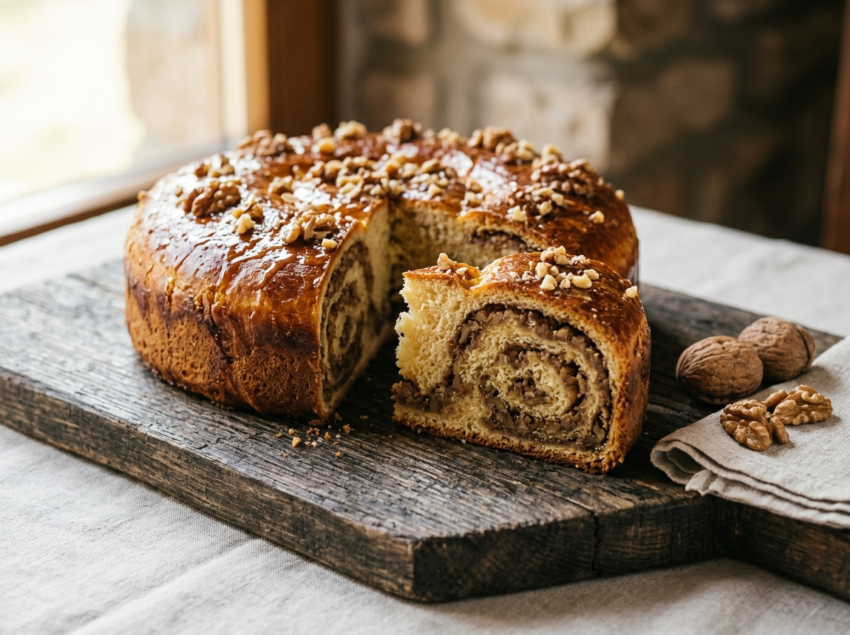
This cake comes from the Transylvanian tradition of layered nut pastries made for harvest celebrations and winter holidays. The dough is soft and slightly rich, almost like a brioche, with that same tender, enriched quality you find in a well-made rustic yeasted sweet bread. The filling is dark, sticky walnut paste sweetened with wildflower honey and a hint of cinnamon.
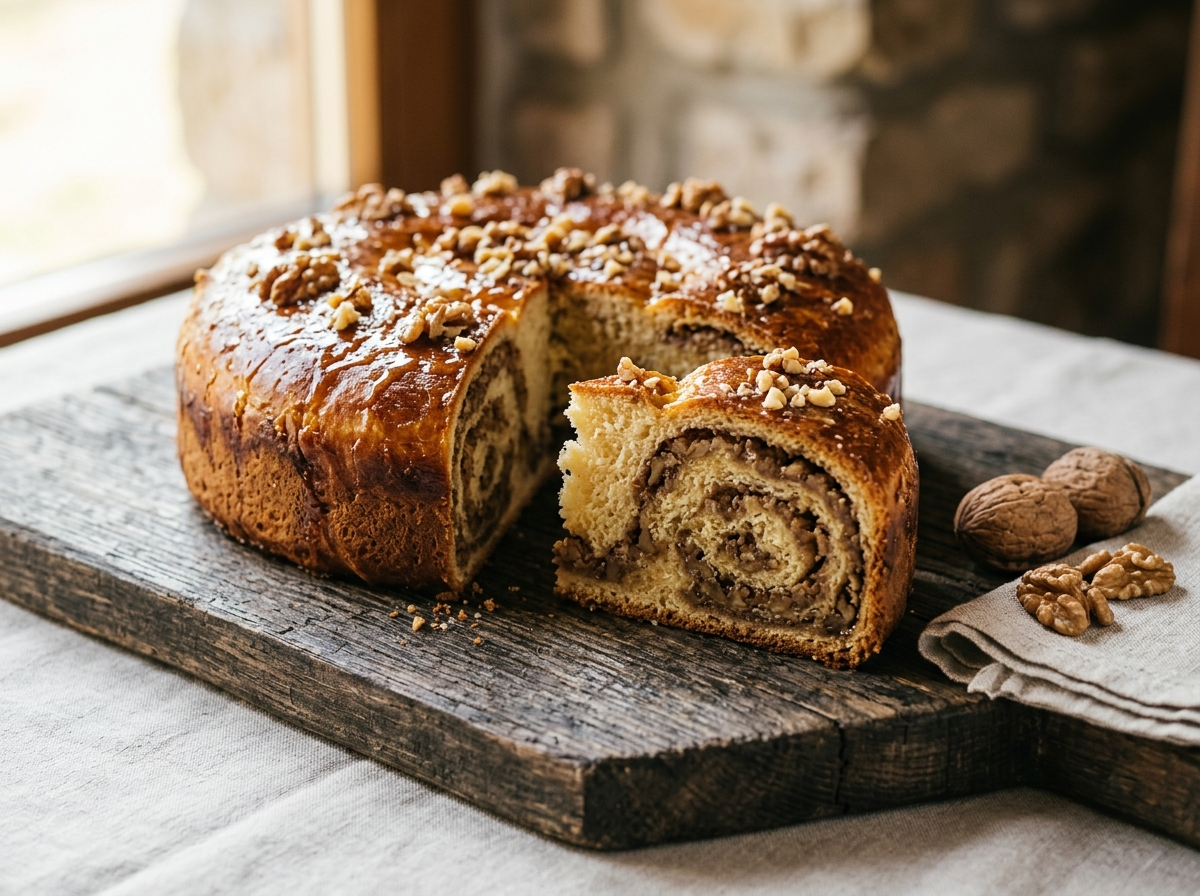
It slices cleanly into neat rounds. The layers spiral when you cut through it, and each one carries that deep, nutty sweetness without being cloying.
I first made this after finding a handwritten version in a Romanian cookbook from the 1970s. I’ve adjusted the honey ratio and added lemon zest to the filling, which lifts the whole thing.
Why You’ll Love This Recipe
- Swirled walnut-honey layers look impressive with minimal effort
- Yeasted dough stays soft and moist for days
- Wildflower honey gives the filling a floral, complex sweetness
- Works as a dessert, breakfast pastry, or afternoon treat
Ingredient Notes
- all-purpose flour: Standard all-purpose flour works well here. Bread flour gives a slightly chewier crumb if you prefer more structure.
- active dry yeast: Proof it in warm milk before mixing to make sure it’s active. Instant yeast works too – skip the proofing step and add it directly to the dry ingredients.
- wildflower honey: Wildflower honey gives a floral depth that pairs well with walnuts. Acacia honey is milder and works if that’s what you have.
- walnuts: Toast the walnuts lightly before grinding – it brings out a richer, more roasted flavor in the filling. Hazelnuts can substitute for a slightly sweeter result.
- whole milk: Full-fat milk makes the dough more tender. Plant-based milk like oat milk works as a dairy-free option, though the dough will be slightly less rich.
- unsalted butter: Softened butter is worked into the dough after initial mixing, similar to brioche technique. Coconut oil can substitute but will alter the flavor.
- lemon zest: Just one teaspoon in the filling cuts through the sweetness and keeps the honey flavor bright. Orange zest is a good swap if you prefer warmer citrus notes.
- ground cinnamon: A small amount goes a long way. Romanian versions often use a pinch of ground cloves alongside cinnamon for a spicier filling.
Transylvanian Honey Nut Cake
Ingredients
Method
- Combine warm milk, yeast, and 1 teaspoon of the sugar in a small bowl. Stir and let sit for 8 to 10 minutes until foamy.
- In a large bowl, whisk together flour, remaining sugar, and salt. Make a well in the center and add the yeast mixture and eggs.
- Mix until a shaggy dough forms, then turn out onto a lightly floured surface and knead for 5 minutes until smooth.
- Add the softened butter a tablespoon at a time, kneading it in fully before adding the next piece. Continue kneading for 6 to 8 minutes until the dough is smooth, elastic, and slightly tacky.
- Place dough in a lightly oiled bowl, cover with a clean kitchen towel, and leave to rise at room temperature for 1 hour or until doubled in size.
- Toast walnuts in a dry pan over medium heat for 3 to 4 minutes, shaking often, until lightly golden and fragrant. Let cool completely.
- Pulse toasted walnuts in a food processor until finely ground. Do not over-process into a paste.
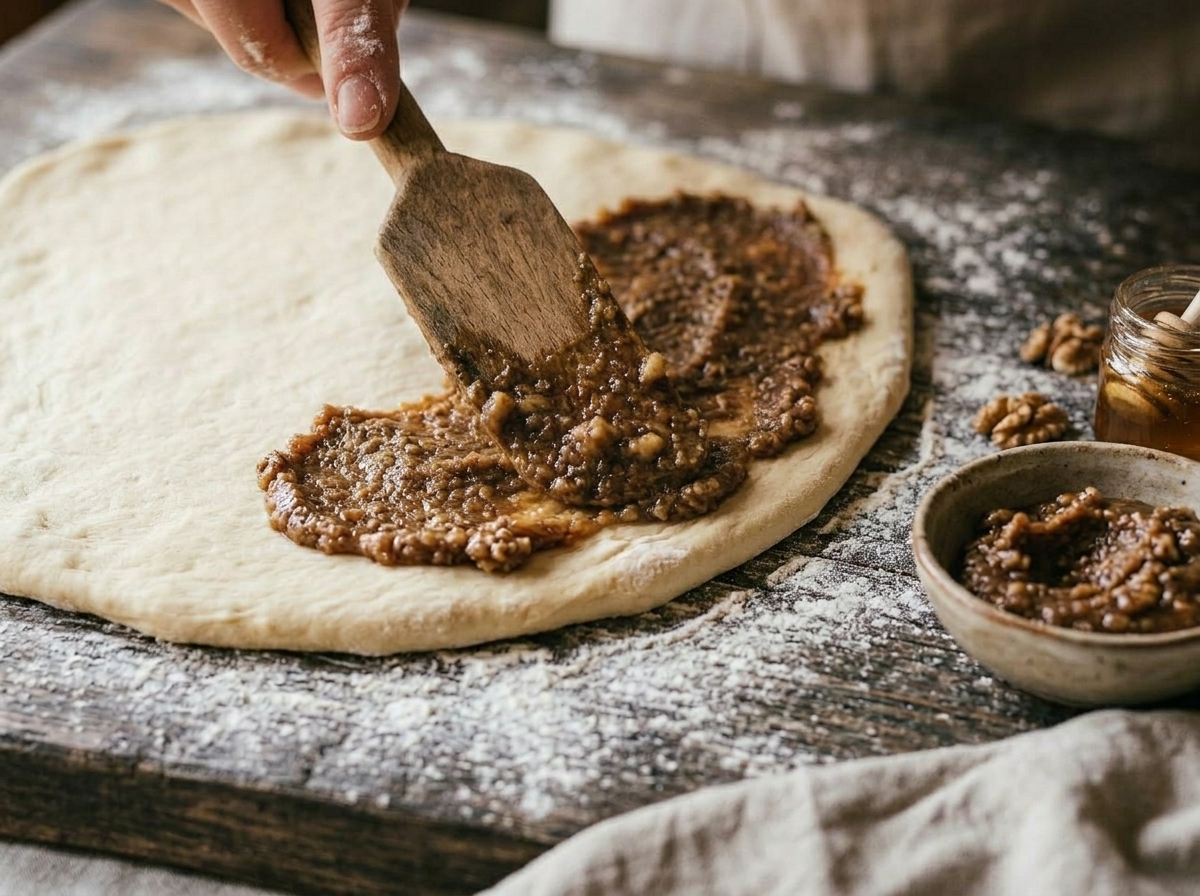
- Combine ground walnuts, honey, sugar, lemon zest, and cinnamon in a bowl. Stir until a thick, spreadable paste forms. Add the milk one tablespoon at a time if the mixture seems dry.
- Heat the oven to 180 C / 355 F. Grease a 900 g / 2 lb loaf pan with butter and line with parchment paper.
- Punch down the risen dough and turn it out onto a lightly floured surface. Roll into a rectangle roughly 40 cm x 30 cm / 16 in x 12 in, about 4 mm thick.
- Spread the walnut filling evenly over the dough, leaving a 2 cm border on all sides.
- Starting from the long edge, roll the dough into a tight log. Pinch the seam and both ends firmly to seal.
- Place the log seam-side down in the prepared loaf pan. Cover loosely and rest for 30 minutes until slightly puffed.
- Brush the top evenly with beaten egg. Bake for 38 to 40 minutes until deep golden brown on top and the internal temperature reads 88 C / 190 F.
- Remove from the oven and immediately brush the top with warmed honey. Let cool in the pan for 15 minutes, then transfer to a wire rack to cool for at least 30 minutes before slicing.
Notes
Tips for Success
- Toast walnuts at 160 C / 320 F for 8 minutes before grinding so the filling tastes deeper and less raw.
- Roll the dough to an even 4 mm thickness so the filling-to-dough ratio stays consistent through each layer.
- Let the shaped cake rest for 30 minutes before baking so the dough relaxes and puffs into a soft, even loaf.
- Brush the top with honey thinned with a teaspoon of warm water right after baking for a glossy, sticky finish.
- Use a sharp serrated knife and a gentle sawing motion to cut slices without compressing the soft layers.
Variations
- Swap walnuts for ground hazelnuts and add a tablespoon of cocoa powder to the filling for a chocolate-hazelnut version.
- Add 2 tablespoons of rum-soaked raisins to the walnut filling for a classic Transylvanian holiday variation.
- Use orange zest and a pinch of cardamom instead of lemon and cinnamon for a more aromatic, Middle Eastern-inflected filling.
Storage and Reheating
Store the cake wrapped tightly in plastic wrap or in an airtight container at room temperature for up to 3 days. The honey in the filling keeps it moist longer than most yeasted cakes.
For longer storage, wrap individual slices in plastic wrap and freeze for up to 2 months. Thaw overnight at room temperature.
To refresh a slice, warm it in a 150 C / 300 F oven for 8 minutes or in a microwave for 20 seconds. The filling softens back to its original texture.
Serving Suggestions
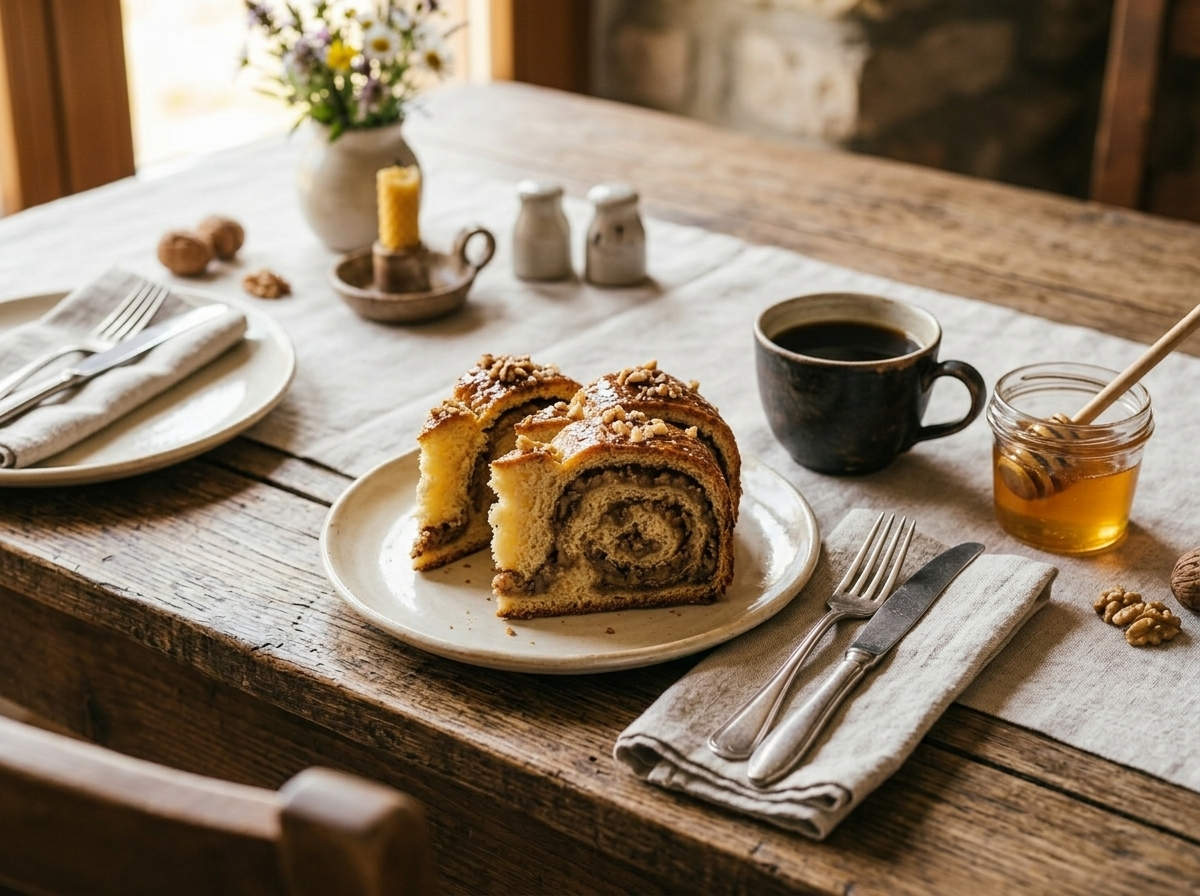
Serve thick slices with black coffee or a strong Romanian-style tea. The bitterness of the coffee works against the honey sweetness in a way that makes you want another slice.
For a more indulgent plate, add a small spoonful of sour cream or crème fraîche on the side, the way a creamy Nordic-style dessert balances richness with tang. The tang cuts through the richness of the walnut filling.
At room temperature the flavors are most distinct. If you’ve refrigerated it, give it at least 20 minutes to come back to room temperature before serving.
FAQ
Why is my honey nut cake filling leaking out during baking?
The filling leaks when it’s too wet or when the dough is rolled too thin at the edges. Make sure the honey-walnut mixture is thick and paste-like before spreading, and leave a 2 cm border around the dough edges when you roll it up.
Can I use pecans instead of walnuts in the Transylvanian filling?
Yes, pecans work well and give a slightly buttery, milder flavor. The texture after grinding is similar to walnuts, so the filling holds together the same way.
Can I shape and refrigerate this cake overnight before baking?
Yes. After shaping, cover the cake tightly with plastic wrap and refrigerate overnight. Take it out 45 minutes before baking and let it come to room temperature and finish proofing before it goes into the oven.
What’s the difference between Transylvanian honey nut cake and Hungarian beigli?
Beigli uses a shorter, less enriched pastry dough and is typically rolled into a tighter log with a drier nut filling, much like the approach behind soft sweet nutty bread rolls from other traditions. Transylvanian honey nut cake uses a yeasted, brioche-style dough and a wetter honey filling, giving it a softer, bread-like texture.
How do I know when the honey nut cake is fully baked?
The top should be a deep golden brown and the internal temperature should reach 88 C / 190 F. Tap the bottom of the loaf – it should sound hollow when done.
Is Transylvanian honey nut cake suitable for a dairy-free diet?
It can be adapted. Replace whole milk with oat milk and use refined coconut oil instead of butter. The crumb will be slightly less tender but the flavor of the walnut-honey filling comes through just as well.
