Ingredients
Method
Make the vanilla custard cream
- Pour the milk into a medium saucepan, add the split vanilla bean and seeds, and bring to a bare simmer over medium heat. Remove from heat and let it steep for 10 minutes, then fish out the pod.
- Whisk the egg yolks, sugar, and cornstarch together in a bowl until pale and smooth.
- Pour the warm vanilla milk into the yolk mixture in a slow stream, whisking constantly to avoid scrambling the eggs.
- Return everything to the saucepan over medium-low heat. Stir constantly with a silicone spatula, scraping the base and sides, until the custard thickens and starts to pull away from the pan - about 4 to 5 minutes.
- Remove from heat, stir in the butter until melted and glossy, then press a sheet of plastic wrap directly onto the surface. Refrigerate until completely cold and firm, at least 2 hours or overnight.
Make the Danish dough
- Combine flour, yeast, sugar, and salt in the bowl of a stand mixer. Add the warm milk, beaten egg, and softened butter. Mix with the dough hook on medium speed for 5 minutes until smooth. The dough should clear the sides of the bowl.
- Shape into a rough rectangle, wrap in plastic wrap, and refrigerate for 1 hour.
- While the dough chills, place the cold lamination butter between two sheets of parchment and beat it with a rolling pin into a flat 18 x 18 cm square. It should be cold but pliable - not cracking. Refrigerate if it gets too soft.
- On a lightly floured surface, roll the chilled dough into a 36 x 18 cm rectangle. Place the butter square in the center and fold the dough sides over it like an envelope, pinching the edges to seal.
- Roll out to a 50 x 18 cm rectangle, working gently to keep the butter from breaking through. Fold into thirds like a letter. This is the first fold. Wrap and refrigerate for 30 minutes.
- Repeat the roll-and-fold process two more times for a total of three folds, chilling 30 minutes between each. After the final fold, refrigerate for at least 30 minutes before shaping.
Shape and fill the pastries
- Heat the oven to 200 C / 390 F. Line two baking sheets with parchment paper.
- On a lightly floured surface, roll the laminated dough to a roughly 40 x 30 cm rectangle, about 4 mm thick. Cut into 8 squares, approximately 10 x 10 cm each.
- To make a classic Danish shape, fold the corners of each square into the center and press down firmly to hold. Alternatively, fold two opposite corners in to form a diamond window shape.
- Transfer shaped pastries to the lined baking sheets, spacing them 5 cm apart. Cover loosely with plastic wrap and proof at room temperature until visibly puffed, about 60 to 90 minutes.
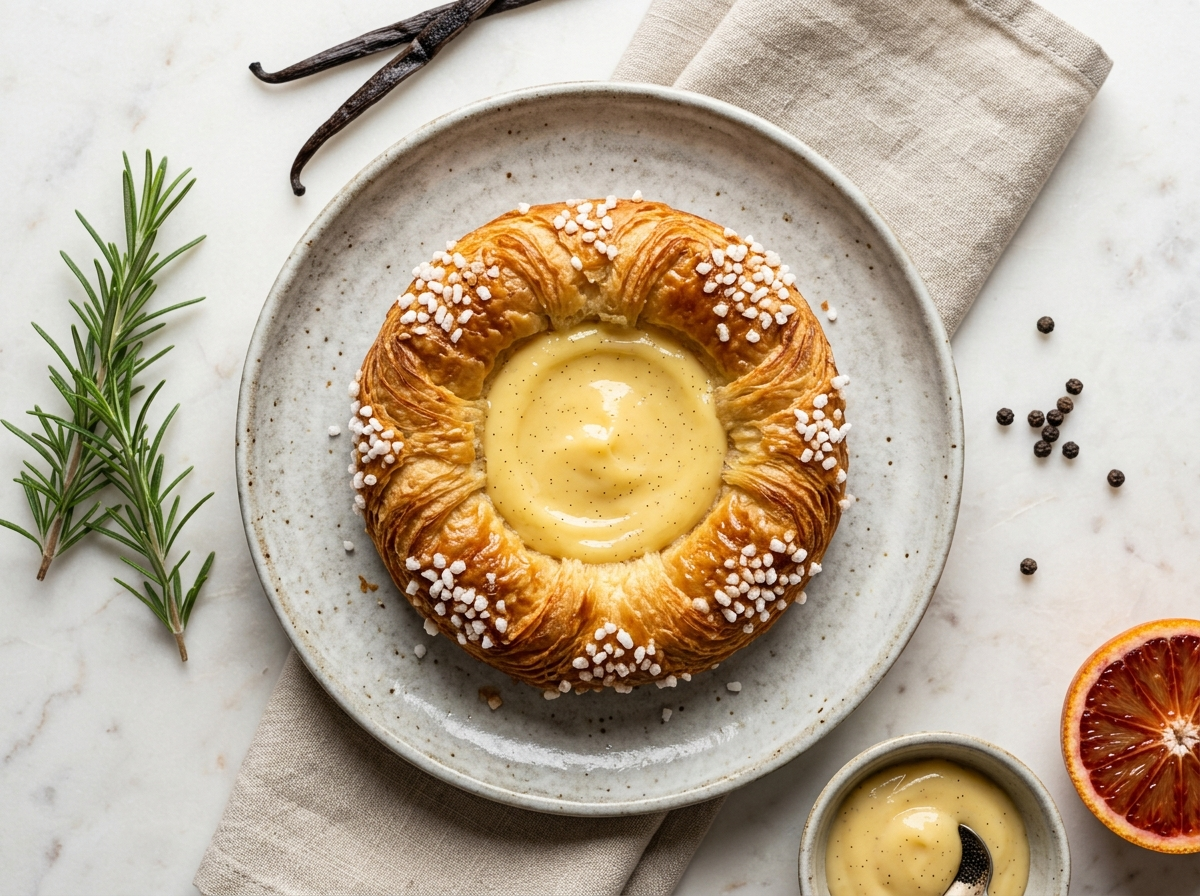
- Brush the exposed dough edges with egg wash. Spoon or pipe about 1 1/2 tablespoons of the cold vanilla custard into the center of each pastry.
- Scatter pearl sugar or flaked almonds over the edges if using.
Bake
- Bake in the preheated oven for 18 to 22 minutes, rotating the trays at the 10-minute mark, until the pastries are deep golden brown and the custard is just set with a slight wobble.
- Cool on the tray for at least 10 minutes before serving. The custard firms up as it cools.
Notes
The dough and custard can both be made the night before and refrigerated separately - shape and bake the next morning for fresh pastries with much less same-day effort.